

Substantial Air Slip Ring for Reliable High-Current Transmission in Rotating Systems
2026-10-28
Most slip rings are fine until the current climbs. Then the real engineering starts—thermal management, brush life, and contact stability all get tested at once. MOFLON’s substantial air slip rings are designed precisely for that moment, delivering reliable high-current transmission in rotating systems that can’t afford downtime.
Why Rotating High-Current Systems Need More Than a Basic Contact
When a slip ring or rotary joint carries hundreds of amps, the contact interface becomes a point of intense thermal and mechanical stress. A basic spring-loaded carbon brush may work fine for signal circuits or modest power, but high-current rotation demands a fundamentally different approach. Small imperfections in surface finish, brush alignment, or brush pressure can lead to localized overheating, arcing, and rapid wear. In rotating high-current systems, the contact must maintain consistent low resistance across the entire revolution, not just at one lucky spot. Without that, you get hot spots that degrade the contact surfaces and eventually cause failure.
The real challenge is balancing force, speed, and current density. Too little brush pressure and the contact bounces under vibration or high rpm, creating micro-arcing that erodes the conductive surfaces. Too much pressure and friction generates excess heat, softening the metal and accelerating mechanical wear. High-current designs often use multiple contact points or specialized materials like silver-graphite composites to spread the load. A basic contact simply cannot handle the combined demands of high amperage, continuous rotation, and harsh environments — it needs redundant paths, controlled spring forces, and thermal management built into the brush holder assembly.
Another overlooked factor is the effect of current on the contact surface itself. At high current densities, electromigration and material transfer become significant. The brush and ring can develop uneven wear patterns, grooves, or even welding of tiny asperities during momentary interruptions. That is why industrial rotary systems for welding, plating, or wind turbines use purpose-built high-current contacts with tuned metallurgy and precise mechanical alignment. They are designed to survive thousands of hours of rotation without developing hot spots or requiring frequent maintenance — something a basic off-the-shelf contact was never engineered to do.
How an Air Slip Ring Keeps Temperature Rise in Check
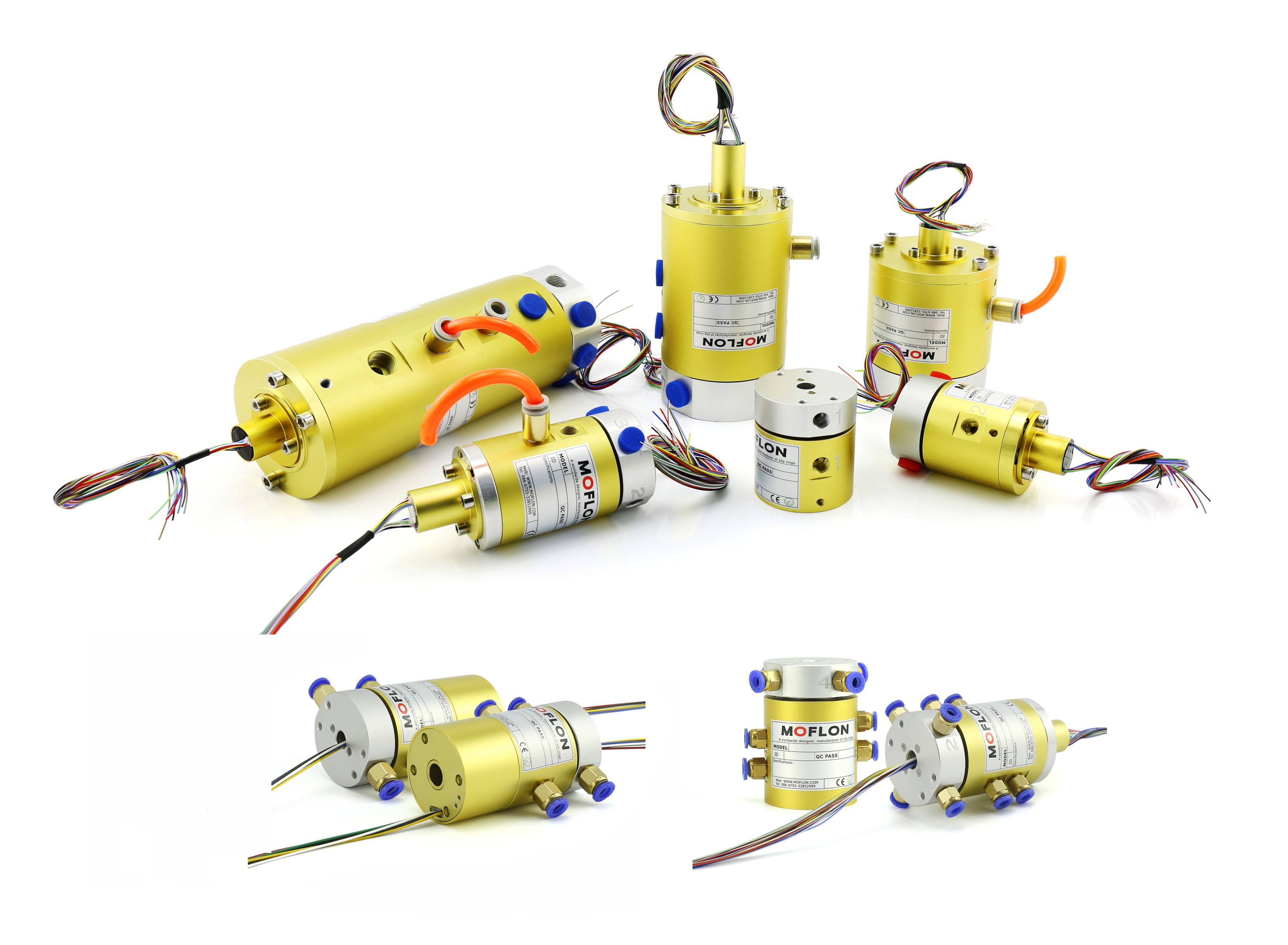
Air slip rings rely on a continuous flow of ambient air to carry heat away from the rotating interface. Unlike sealed units that trap thermal energy, the open design lets cool air pass over the brush contacts and conductive rings during operation. This steady exchange prevents hot spots from forming, even under sustained high-speed rotation.
Engineers further manage temperature by selecting brush materials with low friction coefficients and matching them to ring surfaces that resist oxidation. Reduced mechanical drag means less heat generated at the source, while the inherent ventilation of the housing dissipates whatever warmth does build up. Some models include radial vents or finned exteriors to boost convective cooling without adding moving parts.
The result is a passive thermal management strategy that keeps internal temperatures well below the threshold where resistance rises or insulation degrades. By letting the surrounding air do the heavy lifting, an air slip ring maintains stable electrical performance without the need for liquid coolants or complex chillers.
Inside the Materials That Endure Constant Sliding and Heavy Loads
Materials tasked with enduring constant sliding and heavy loads rarely reveal their secrets from the outside. What truly matters is the way their internal structure shifts, bonds, and sometimes sacrifices itself under pressure. In a bearing race or a cam follower, the surface may look polished and unyielding, yet just beneath it a complex choreography of crystalline slip, phase transformation, and micro-scale welding takes place. The goal is not to avoid all damage—that is impossible—but to manage it so predictably that the component keeps functioning long after lesser alloys would have seized or galled.
The most successful materials for these conditions share a quiet paradox: they must be hard enough to resist abrasion, yet tough enough to absorb energy without fracturing. Through-hardened steels, for example, rely on a martensitic matrix peppered with fine carbides that act like tiny anvils, spreading contact stress over a larger area. Meanwhile, the retained austenite that many engineers once feared actually proves beneficial in controlled amounts, transforming into martensite at the contact zone to create a self-hardening surface. This dynamic response—where the material adapts its own microstructure under stress—is what separates a durable sliding surface from one that simply measures high on a hardness scale.
Another layer of endurance comes from the deliberate introduction of compressive residual stresses. Shot peening, deep rolling, or specialized heat treatments can leave the outer few hundred microns of a component in a state of mechanical compression. When a heavy load slides across that surface, the tensile stress that would normally initiate a crack is partially cancelled out, delaying fatigue by orders of magnitude. It is a subtle engineering trick, but one that turns an ordinary steel shaft into a component that can survive millions of cycles without visible wear. In the end, the materials that endure are not just chosen—they are coaxed, through metallurgy and mechanical treatment, into a state of constant, quiet self-repair at the microstructural level.
Sizing the Conductor Path for Amperage Without Voltage Drop
Sizing for amperage without considering voltage drop means selecting the smallest conductor cross-section whose continuous current rating exceeds the load under actual installation conditions. That starts with the load profile: noncontinuous loads count at 100%, continuous loads at 125%, and motors may require additional branch-circuit sizing per their full-load current tables. The base ampacity from the relevant table is only a starting point.
Then adjustment factors enter. Ambient temperature above 30°C (86°F) derates the conductor, and more than three current-carrying conductors in a raceway or cable require further reduction. These factors stack multiplicatively, not additively. A common oversight is applying the 90°C insulation ampacity for derating but then using a 75°C termination ampacity for final selection; the lower of the two governs. For example, a 90°C-rated copper conductor may be derated from its 90°C value for conduit fill, but its final allowable ampacity must still not exceed the 75°C termination limit unless all devices are listed for 90°C.
When voltage drop is deliberately ignored, the conductor path is often shorter than about 100 feet and the load is within normal branch-circuit range. But even then, the overcurrent protective device must protect the conductor: after all adjustments, the conductor ampacity must be at least equal to the rating or setting of the breaker or fuse. In many cases this forces a larger gauge than the raw load current suggests, not because of distance, but because standard breaker sizes and derated ampacity values rarely align neatly. Parallel conductors can solve high-ampacity needs, but each paralleled conductor must have identical length, material, cross-section, and insulation, and must be terminated in the same manner to share current equally.
Common Installation Pitfalls That Undermine High-Current Transfer
Many high-current systems fail not because of component ratings but because of overlooked installation details that introduce resistance at connection points. A loose busbar joint, for example, may pass a visual inspection yet create a hot spot under load, gradually degrading conductivity and insulation. Even a thin oxide layer on contact surfaces, often invisible without proper cleaning, can push voltage drop beyond acceptable limits and trigger unnecessary protection trips.
Cable management choices also play a decisive role. Running parallel conductors with uneven lengths forces current to crowd into the shorter path, overloading that conductor while underutilizing its neighbors. Similarly, bundling high-current cables tightly without accounting for mutual heating can raise operating temperatures well above design assumptions, accelerating insulation aging and reducing overall transfer efficiency. These are not exotic failures; they show up in everyday installations where small shortcuts accumulate.
Finally, torque values on bolted connections deserve more respect than they usually get. Under-torquing leaves joints vulnerable to vibration and thermal cycling, while over-torquing can deform contact surfaces or strip threads, both leading to unpredictable resistance changes over time. The best practice is to treat every connection as a calibrated interface, verifying cleanliness, alignment, and clamping force before energizing the circuit.
Signs of a Slip Ring Built for Years of Interrupted Duty
Most slip rings fail not from continuous rotation, but from the relentless start-stop cycles that mimic real-world duty. Look closely at the brush assembly—a design meant for interrupted service uses a multi-finger, precious metal brush with a low, consistent contact force. Instead of a single stiff contact that skips or arcs during sudden stops, each finger moves independently, maintaining contact even when the ring decelerates abruptly. You'll also notice the ring surface: rather than a mirror polish, it has a faint, uniform wear pattern that develops after thousands of partial revolutions, a sign the materials were chosen to handle micro-welding and oxidation without pitting.
Another clue sits in the housing and bearing arrangement. Units built for stop-and-go operation often feature a preloaded double bearing set that removes axial play, so the ring stack doesn't shift when the load jerks. The lead exits are typically strain-relieved with a flexible service loop or a potting compound that tolerates repeated flexing. Open one up and you may see a labyrinth or lip seal rather than a simple o-ring—interrupted duty lets contaminants settle, and a good seal keeps them from grinding into the contact zone during the next rotation.
Finally, check the temperature behavior after a series of short runs. A slip ring meant for this life rarely shows hot spots on the outer housing, because its internal clearances and thermal mass are sized for intermittent heat spikes, not steady-state dissipation. The brush springs won't lose tension after a few hundred cycles; they're often made from a creep-resistant alloy. If the manufacturer lists test data for millions of start-stop cycles at rated current, that's the strongest signal—no generic continuous-duty ring survives that kind of abuse without showing the same wear signatures.
FAQ
The air gap acts as a natural dielectric, allowing the unit to handle elevated current loads without the thermal breakdown common in solid-insulation designs. Air also disperses heat more evenly across the rotating interface, which keeps contact resistance stable even at sustained amperage.
Large wind turbine generators, rotary cranes, radar pedestals, and heavy industrial turntables see the biggest gains. Any application where the rotor must carry hundreds or thousands of amps while turning continuously is a strong candidate, especially if space is available for a larger ring diameter.
Solid insulators can crack or carbonize under thermal cycling, creating leakage paths. Air insulation avoids that failure mode entirely, and because there is no potting compound to degrade, the ring can tolerate voltage spikes and humid environments with fewer unexpected outages.
Yes, but the maximum speed depends on the ring diameter, brush pressure, and balance tolerance. Units are typically dynamically balanced at the factory, and the air gap reduces frictional drag compared to tightly packed slip ring stacks, so higher RPMs are achievable without excessive wear.
Ratings commonly start around 500 A and can exceed 5000 A per circuit, with voltage classes from 600 V to 15 kV or more. The exact figures depend on ring spacing, cooling method, and whether forced air is used, but the design is intended for heavy industrial power transfer.
The open-air construction allows natural convection around the rings, and many designs add radial cooling fins or a dedicated blower. Some versions include embedded temperature sensors that throttle current or activate auxiliary cooling, preventing hot spots at the brush contact area.
Routine checks involve monitoring brush wear, verifying air gap cleanliness, and inspecting for dust or moisture ingress. Brushes typically need replacement after thousands of operational hours, but because the insulation is air rather than a solid dielectric, there is no resin cracking or re-potting work during service.
Conclusion
Rotating equipment carrying hundreds of amps cannot rely on a simple brush-on-ring contact. At high currents, even small resistance creates hot spots, arcing, and voltage sag that undermines motors, cranes, or wind turbine pitch systems. A substantial air slip ring addresses this by combining an open-air interface with generously sized conductors and a heat-dissipating geometry. Instead of enclosing the sliding contact where heat builds, the air gap allows natural convection and radiative cooling, keeping junction temperatures within safe margins. The contact materials themselves are chosen for endurance: silver-graphite brushes paired with hardened copper alloy rings offer low friction, low wear, and stable voltage drop across millions of revolutions. Conductor cross-sections are deliberately oversized so that full-load amperage passes without measurable loss, and each ring is engineered to shed debris rather than trap it.
Many high-current rotating systems fail prematurely because the slip ring was installed as an afterthought. Common pitfalls include undersized cabling to the ring terminals, misaligned brush holders that create uneven pressure, and inadequate clearance around the assembly, which blocks airflow and turns a well-designed ring into a heat trap. A unit built for interrupted duty shows specific signs: brush wear indicators that remain visible from outside, split rings that can be replaced without pulling the entire rotor, and insulation rated for continuous thermal cycling. When sized correctly and installed with proper ventilation, a substantial air slip ring maintains consistent contact resistance, avoids voltage drop at peak draw, and delivers the kind of reliability that keeps a rotating high-current system online season after season.
Contact Us
Contact Person: Xiangpin Li
Email: [email protected]
Tel/WhatsApp: 86 186 1706 8578
Website: https://www.moflon.com