
Sliding DU Bushing Exporter Selection Tips for Industrial Buyers
2026-11-16
Sourcing sliding DU bushings from overseas exporters can feel like a gamble—one wrong supplier and you're stuck with premature wear, hidden costs, or delivery delays. Industrial buyers need sharper criteria than just a low quote. That's where XIAYI changes the equation, offering a reliable benchmark for what a top-tier exporter should deliver.
Material certificates alone won't tell you if the bushing survives your load cycle
A material certificate lists tensile strength, elongation, and hardness—values measured under clean, monotonic loading. But a bushing in service rarely sees a single pull to failure. Your load cycle likely involves repeated compression, shear, or torsion, often combined with temperature swings and vibration. That certificate says nothing about how the material behaves after ten thousand cycles, or whether microcracks will initiate at a stress concentration you never anticipated.
Fatigue life depends on surface finish, fit tolerance, lubrication condition, and the exact load path through the housing. Two identical bushings made from the same certified steel can fail at wildly different cycle counts if one was installed with slight misalignment or ran dry for a few seconds. The certificate gives you a starting point, not a survival guarantee.
What you actually need is a duty-cycle test on a prototype, or at minimum a strain gauge reading from the real assembly. Compare that measured stress range against fatigue data for the exact material condition—heat treatment, hardness, and any prior machining damage all matter. Only then can you judge whether the bushing will survive your load cycle, not just pass a chemistry check.
Ask for failure examples, not just polished success stories
Most teams love to talk about what worked, but the real lessons usually sit in the projects that went sideways. When you ask directly for failure examples, you stop hearing rehearsed highlights and start getting the unvarnished details—the wrong assumptions, the late-night reversals, the customers who walked away. Those stories reveal the actual constraints and trade-offs that polished case studies leave out.
Instead of letting people lead with their wins, push for the breakdowns: 'Tell me about a launch that missed the mark' or 'What would you do differently if you had to redo that quarter?' The answers often expose gaps in process, faulty metrics, or hidden risks that a success-only narrative would never mention. This approach also signals that you value honesty over impression management, which tends to produce more candid conversations.
Finally, listen for the silence or the hesitation. If someone struggles to recall any failure, that itself is information—either the culture punishes mistakes, or they're not reflecting deeply enough. By making failure examples a routine part of your questions, you build a picture of how an organization actually learns, rather than how it wants to be seen.
Packing standards matter more than you think for corrosion-prone shipping routes
When cargo travels through humid, salt-laden air for weeks on end, the difference between a properly sealed crate and a loosely wrapped pallet isn't just cosmetic—it's the line between arriving intact and arriving as a costly pile of rust. Many shippers treat packing standards as a box-ticking exercise, but on routes where corrosion is a constant threat, the smallest gap in a barrier film can become a starting point for electrochemical decay that spreads unnoticed beneath the surface.
The real issue isn't whether you use desiccants or VCI paper—it's whether your packing protocol accounts for the unique stresses of each leg of the journey. A container that sits on a dock in Singapore for three days before crossing the Indian Ocean faces a different moisture profile than one moving directly from Rotterdam to Montreal. Without clear, route-specific packing standards, even high-quality materials fail because they're applied the same way regardless of destination, stacking patterns, or ventilation conditions.
What separates resilient shipments from ruined ones is often the willingness to treat packing as a dynamic process rather than a static checklist. Teams that document actual humidity readings inside the crate, adjust barrier placement based on load shifts, and inspect seals at transfer points see dramatically fewer claims. The cost of these steps is trivial compared to the expense of rejected goods, delayed production lines, and damaged client relationships—yet most companies only discover this after a particularly expensive lesson.
Watch how they respond when you push for wear simulation data
Push for wear simulation data and you'll quickly see who actually runs these analyses and who just talks about them. Some will hand over detailed curve sets, boundary conditions, and material cards without blinking. Others will stall, offer a glossy brochure instead, or claim the data is "proprietary" without explaining how a simple contact pressure distribution is a trade secret.
Pay attention to the kind of pushback you get. A vendor who deflects by saying "trust our field results" but never produces the underlying wear maps usually hasn't done the simulation at all. The ones worth working with will walk you through mesh sensitivity, Archard coefficients, and why they chose a particular contact algorithm. If they get defensive or vague when you ask for the raw output files, that tells you everything.
This isn't about being difficult—it's about seeing whether their wear claims rest on engineering or marketing. Real simulation work survives scrutiny. A partner who shares results, explains assumptions, and admits when a model breaks down is far more valuable than one who hides behind polished slides. How they respond to a direct request for wear data is a reliable signal of their technical depth.
Regional export experience can save weeks of customs delays
Customs hold-ups rarely come from a single missing form. They pile up when a shipper treats every border the same way. Teams that have already moved goods through Southeast Asian ports, for example, know that certain commodity codes need supporting lab reports before arrival, and that a broker's local standing can matter more than the invoice itself. That kind of regional know-how turns a two-week clearance into a two-day one.
Experienced exporters also learn which delays are avoidable and which are not. In parts of Latin America, pre-arrival electronic filing is not optional if you want to skip the physical inspection queue, while in some Gulf states, a consignee's trade license renewal can stall a shipment for days if it is not checked early. These are not tricks; they are repeatable steps that save real time.
This is why companies with regional export experience often quote longer lead times to newcomers but still deliver faster. They front-load document reviews, use local agents who can speak directly to inspectors, and know when to push back on a classification instead of waiting for a ruling. Over a year of regular shipments, those small advantages add up to weeks of dock and warehouse time avoided.
A trial order with your actual operating parameters beats any glossy brochure
A trial order running your actual operating parameters tells you what a brochure never can. Marketing pages show ideal conditions—clean power, steady temperatures, uniform materials. Your floor rarely matches that. Voltage dips, ambient humidity, operator timing, and material batch variations all shape how equipment performs. A small test order under those real constraints gives you numbers you can trust.
Brochures also tend to skip the awkward cases. Intermittent cycling, mixed feedstocks, or less-than-perfect maintenance schedules are where hidden weaknesses appear. Running a modest batch in your own environment exposes tolerance drift, warm-up behavior, and how easy it is to clear a jam at 2 a.m. That kind of detail matters more than a polished spec sheet.
A trial order also shifts the conversation from promises to evidence. Your operators see the output, measure the scrap rate, and note the noise level. That firsthand experience builds internal buy-in faster than any vendor presentation. It turns a purchasing decision into a verification process, which saves time and reduces the risk of an expensive mismatch.
FAQ
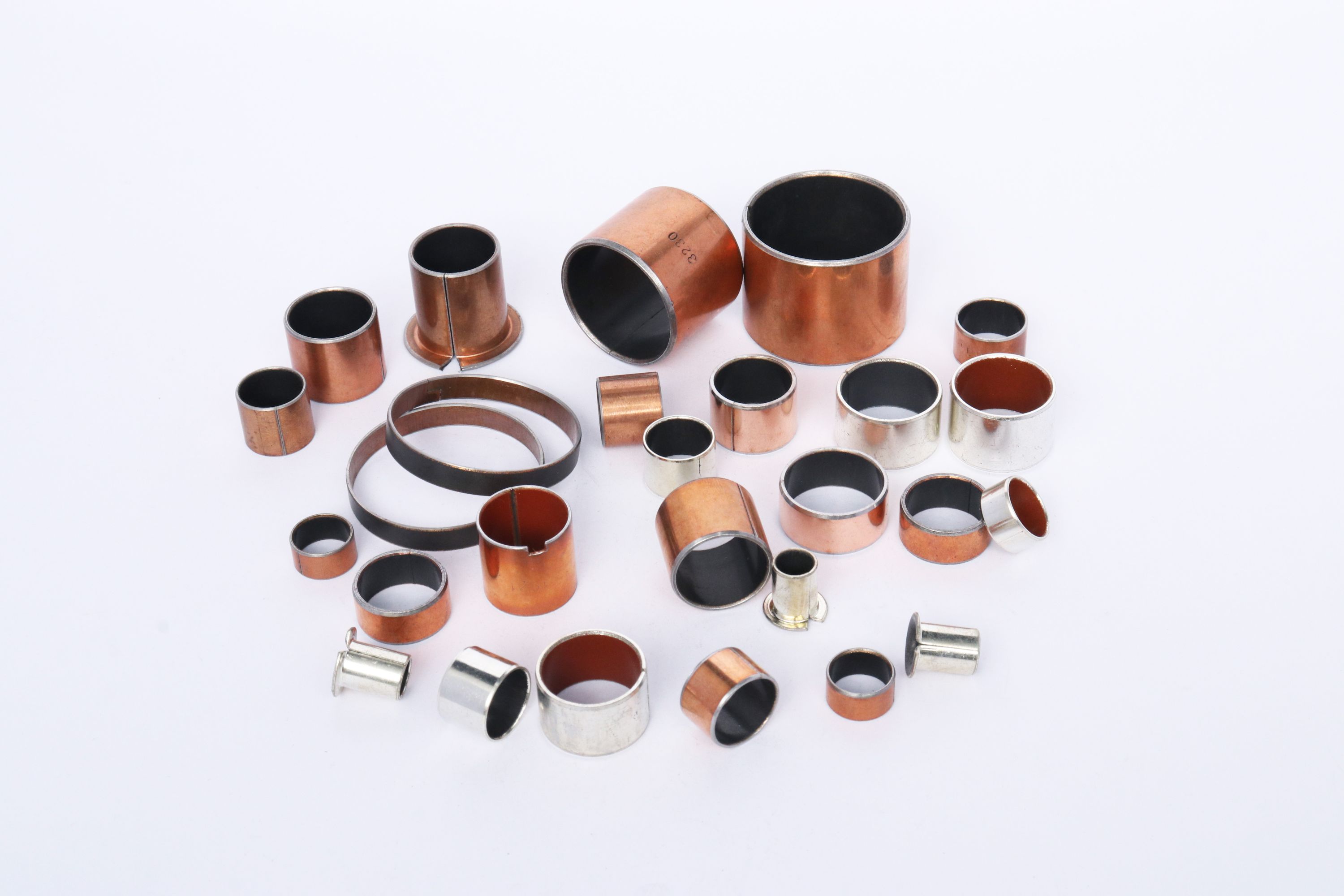
A dependable exporter typically shows deep familiarity with the DU structure—steel backing, porous bronze sinter, PTFE-lead overlay—not just catalogue photos. They can answer technical questions about PV limits, shaft tolerances, and running-in behavior without long delays, and they offer traceable mill certificates instead of only commercial invoices.
Ask for third-party test reports covering hardness, layer thickness, and friction coefficient under boundary lubrication. Compare those numbers against the operating conditions: load, speed, temperature, and mating surface roughness. A serious exporter will also share sample batches for in-house validation before the first container leaves.
Request ISO 9001 or IATF 16949 certification if the bushings go into automotive or high-wear equipment, plus RoHS and REACH declarations when exporting to the EU. Material certificates should identify the steel grade, bronze powder, and PTFE compound; ask for dimensional inspection sheets per lot, not just a generic COC.
In-house manufacturing usually gives better control over sintering quality and dimensional repeatability, but only if the exporter has real production lines and not just a warehouse. Sourcing from multiple factories can work if the exporter has a documented vendor audit process and owns the QC checks; otherwise you risk mixed batches and inconsistent friction layers.
Watch for vague incoterms, reluctance to provide HS codes, unclear country of origin documentation, or prices that seem detached from raw material costs. If they cannot name the freight forwarder or offer a packing list with net/gross weights and case dimensions, they may not handle cross-border logistics regularly.
Lead time affects not just when the bushings arrive but also inventory carrying costs and line stoppage risk. Packaging matters because DU bushings have a soft running layer; loose bulk packing or insufficient separation can cause surface damage, and damaged liners usually fail early. Ask for export-grade cartons, rust protection for the steel backing, and a realistic production schedule with buffer.
Yes, a capable exporter should offer tooling for non-standard bore sizes, flange options, or alternative backing materials like stainless steel or bronze. This requires engineering review of the drawing, tolerance stack, and intended PV range. If the exporter just says yes without technical questions, treat that as a warning.
Expect clear handling of claims: replacement for dimensional or material defects, return authorization process, and a named contact for warranty issues. Good exporters also provide installation guidance, storage recommendations, and sometimes third-party inspection reports if you order under L/C terms. Support should not end after shipment.
Conclusion
Most industrial buyers eventually learn that a material certificate only proves the DU bushing meets a nominal composition. It says nothing about how the bronze layer behaves after 50,000 cycles under your specific side load, ambient temperature, and lubrication intervals. Smart sourcing teams skip the polished case studies and ask direct questions like "Which customer had a bushing seize in the first 200 hours, and what did you change?" That kind of pressure reveals whether the exporter understands failure modes rather than just sales points. Packing also gets overlooked until a container arrives with rust staining on the steel backing. If your route passes through high-humidity ports or sits at anchor for weeks, VCI paper, sealed poly bags, and desiccant placement are not optional—they are the difference between parts that install clean and parts that need rework.
The same logic applies to wear data. Ask for a pv-curve generated under conditions similar to yours, not a generic lab sheet. If the exporter stalls, switches topics, or sends a marketing brochure, treat that as a signal. Regional experience matters too: an exporter who has cleared DU bushings through your country's customs before will know the HS code quirks, labeling rules, and inspection triggers that can otherwise add three weeks to delivery. None of this beats a small trial order run at your actual load, speed, and start-stop frequency. Ten units tested in your own assembly line will tell you more about tolerance stability, surface finish, and break-in behavior than any collection of certificates or glossy photos. Buy from the exporter who accepts that trial as a normal part of doing business.
Contact Us
Contact Person: Leela
Email: [email protected]
Tel/WhatsApp: 8613586885132
Website: https://www.xiayishockparts.com