

Karate Shin Guards Service for Reliable Leg Protection
2026-08-26
Every karateka knows the sting of a poorly timed block—shin against shin, bone on bone. That's where reliable leg protection stops being a luxury and starts being a necessity. But not all shin guards are created equal. In this article, we explore what separates durable, competition-ready gear from the rest, and how PandaWin Sports is redefining the service behind your leg protection.
What We Look for When Inspecting a Karate Shin Guard
Padding density is the first thing you should check, not just how thick the foam looks from the outside. Press your thumb into the centre of the shin plate and along the instep ridge; if it bottoms out too quickly or feels uneven, that guard will not save you from a hard check. We also bend the guard slightly to see if the padding separates from the outer shell or if the stitching pulls away from the edges.
The strap system gets just as much attention. Elastic loops and hook-and-loop closures should hold without cutting off circulation or sliding down mid-session. Run your hand along the inside liner to catch any rough seams, glue spots, or ridges that would dig into skin after twenty minutes of sparring. A guard that shifts, chafes, or needs constant adjusting is a distraction you cannot afford.
Padding That Absorbs Impact Without Slowing You Down
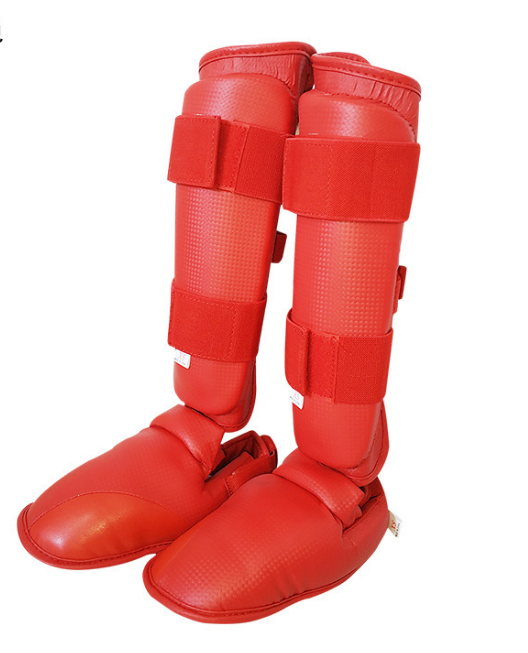
A lot of impact protection comes with a hidden tax—bulk that fights your every move. This padding takes a different route. It spreads force across its surface so hard landings feel less like a punch and more like a firm handshake, yet the profile stays slim enough to forget you're wearing it. Sprint, cut, or drop to the ground; nothing pinches or catches.
The core isn't just foam stacked for thickness. It's a layered structure that firms up on sudden compression but stays pliable during normal motion. That means it reads the difference between a fall and a stride, stiffening only when you need it. You get the shield without the suit of armor.
Athletes keep testing this in the worst conditions—concrete ledges, wooden ramps, rainy turf—and it keeps letting them get up and go again. No energy wasted wrestling stiff panels, no second-guessing a dive. Just padding that works with your momentum instead of against it.
Getting the Fit Right: Why One Size Never Fits All
The phrase “one size fits all” sounds efficient, but in practice it usually signals a compromise nobody asked for. Fit is not just about measurements; it’s about how a garment moves with your body, where it pulls or gaps, and whether it respects the way you actually live. A universal template ignores the fact that shoulders slope differently, torsos vary in length, and what feels comfortable for one person can feel like a straightjacket to another.
Getting the fit right starts with rejecting the myth of the average body. Instead of forcing every shape into the same silhouette, thoughtful design accounts for proportional adjustments, fabric stretch, and construction details that allow for real movement. That might mean offering multiple rises in trousers, grading patterns across a broader size range, or simply acknowledging that a size label is a starting point, not a verdict.
Ultimately, a better fit is a conversation between the wearer and the maker. It shows up in side seams that stay straight, waistbands that don’t dig, and sleeves that let you reach for a shelf without hiking up to your ribs. When clothes are made to accommodate variety rather than erase it, they don’t just look better—they feel like they were meant for you.
The Hidden Weak Points in Most Shin Guards
A lot of players assume that as long as the front plate covers the tibia, they're protected. But most designs leave a strip of bone just below the knee exposed, especially when a striker catches you with a follow-through. The top edge tends to sit too low once you start running, and that gap becomes an easy target for stray studs or a poorly timed block.
Another issue is the strapping system. Elastic cuffs lose tension after a few weeks of sweaty training sessions, and the guard starts rotating outward or slipping down mid-sprint. Once that happens, the hard shell is no longer centered over the shin—it's angled off to the side, leaving the inner edge of the tibia completely unprotected.
Foam density is also rarely questioned. Many budget-friendly options use open-cell foam that flattens permanently after repeated impacts. It still looks fine from the outside, but the shock absorption drops sharply. A guard that felt solid in the store can be almost useless by mid-season, especially for players who block shots or challenge hard in the tackle.
A Maintenance Routine That Keeps Guards Reliable for Years
Most guard failures trace back to the same root: small, overlooked issues that compound over months of vibration and daily use. A practical routine starts with a weekly visual sweep. Run your hand along the mounting brackets and hinges, feeling for any play that wasn't there before. Listen for rattles when the machine cycles — a loose guard often announces itself long before it becomes a hazard. Keep a simple log on the wall next to the equipment; a handwritten note about a slightly bent latch can save you from a full replacement later.
Beyond the quick checks, set aside thirty minutes every month for a deeper pass. Remove the guards on high-cycle machines and inspect the weld points, fastener threads, and any interlock switches for wear or corrosion. Wipe down sliding surfaces and reapply a dry lubricant where the manual allows — wet greases tend to attract grit that accelerates wear. If you find a fastener that has backed off twice in a row, don't just retighten it. Swap in a new lock washer or thread-locking compound; repeating the same fix is a sign the old approach isn't working.
Finally, treat guard maintenance as part of shift handover, not an annual project. Teach operators to report any contact between tooling, stock, or carts and the guards. A scratch in the paint might seem cosmetic, but it often marks the start of a crack or misalignment. When replacement is needed, keep a small stock of common guard panels and hardware on the shelf. That way, downtime stays measured in minutes, and the guards keep doing their job without anyone having to think about them.
Matching Your Guard to Your Training Intensity
Light technical work rewards a loose, structured guard. You don't need to weld your elbows to your ribs or tense your traps; keep the hands up but relaxed, forearms near vertical, and let the gloves hover close enough to intercept. This saves energy for repetition and lets you read angles without burning out your shoulders.
When the pace shifts to hard drilling or full-contact sparring, compact everything. Tuck your chin, raise the lead hand slightly, and anchor the rear hand to your jaw. Expect to take a few glancing shots, so brace your core and keep your weight centered. Small deflections beat wide parries here—you want to stay in position to fire back.
For high-intensity rounds or competition simulation, your guard should breathe with range. Use a taller long guard at kicking distance, then snap into a tight shell or peek-a-boo guard in the pocket. But don't cycle through variations for the sake of it; stick to a default that matches your style, and adjust only when you see a specific threat.
FAQ
The stitching is reinforced and the outer layer resists cracking, so they can take repeated hits without falling apart. A lot of practitioners use them for full-contact drills multiple times a week.
You can wipe them down with a damp cloth and mild soap. Avoid soaking them or tossing them in a machine, because that can degrade the foam. Let them air dry away from direct heat.
They use wide elastic straps with hook-and-loop closures that grip the leg securely. Even during fast footwork and high kicks, the guards generally don't shift around or need constant readjusting.
These work for all levels. Beginners appreciate the extra confidence they get from solid protection, while advanced students rely on them for hard sparring and competition prep.
We carry small, medium, large, and extra-large. Measure around the widest part of your calf and match it to the size chart. If you're between sizes and plan to wear them over a gi, going up one size usually feels more comfortable.
They're shaped to follow the curve of your shin and stay fairly slim, so you keep good mobility. Most people forget they're on after a few minutes of warm-up.
Yes, if the straps or stitching fail within the first year of normal training, we'll repair or replace them at no cost. After that, we can still often fix minor issues for a small fee instead of making you buy a new pair.
They meet the typical padding requirements for WKF-style and most traditional karate tournaments. Always double-check with your specific event organizer, since local rules can vary slightly.
Conclusion
Reliable leg protection starts before you ever step onto the mat. The real service a karate shin guard provides is not just blocking one kick—it's staying in place and absorbing force through an entire sparring session. When we inspect a guard, the first thing we check is how the padding behaves under repeated impact. Good padding doesn't just cushion; it springs back fast, so your third and fourth strikes feel as protected as the first. Too many guards use thick foam that collapses after a few hard sessions. We look for dense, multi-layer padding that spreads force away from the shin bone without adding bulk that slows your footwork. Fit is where most guards fail. One size never fits all, because a guard that slides down mid-combination is as dangerous as no guard at all. We test strap tension around the calf and ankle, and we check for pressure points behind the knee. Hidden weak points often hide in the stitching near the instep and the elastic bands. If those fray early, the guard shifts and exposes the very bone it's supposed to protect.
A maintenance routine is what separates gear that lasts two months from gear that lasts two years. After each session, wipe the guard down with a damp cloth and let it air dry completely—never leave it stuffed in a gym bag. Check the straps for stretched elastic and the outer shell for cracks every couple of weeks. If the guard starts to smell, a mix of water and white vinegar kills bacteria without breaking down the foam. Matching your guard to your training intensity also matters. If you spar hard three times a week, you need a guard with a rigid outer shell and a reinforced instep. For light technical drills, a slimmer, more flexible guard lets you move freely. Don't buy the same guard for both and expect it to hold up. Reliability in leg protection isn't about finding one perfect product; it's about inspecting, maintaining, and choosing based on how you actually train.
Contact Us
Contact Person: Fei Xu
Email: [email protected]
Tel/WhatsApp: +8618631245578
Website: https://www.pandawinsports.com/