

Custom Automatic Lathe Solutions for Precision Manufacturing
2026-08-05
In precision manufacturing, off-the-shelf lathes often fall short. Custom automatic lathe solutions bridge the gap between standard machinery and your exact production needs. At WINNRUI CNC, we don’t just modify machines—we engineer turning systems that align with your tolerances, volumes, and workflow. Discover how tailored automation unlocks consistency and speed that generic equipment can’t match.
Tailored Automation for Complex Part Production
Every intricate component demands a production approach as unique as its design. Off-the-shelf automation simply can't accommodate the tight tolerances, delicate handling, or specialized tooling required for complex geometries. That's why we engineer systems from the ground up—collaborating closely with your team to map out each production stage, from material infeed to final inspection. The result is a seamless integration of robotics, conveyors, and custom end-of-arm tooling that moves your parts with absolute precision, protecting fragile edges and surface finishes while maintaining cycle times that keep you competitive.
Flexibility is built into every solution because complexity rarely means uniformity. Our systems often combine multiple processes—such as vision-guided assembly, laser marking, and automated packaging—within a single cell, eliminating non-value-added handling between stations. We program adaptive paths that respond to real-time sensor feedback, allowing the equipment to adjust for minor variations in part orientation or material behavior without operator intervention. This agility not only improves first-pass yield but also future-proofs your investment, as the system can be re-tasked for new product variants with minimal reprogramming.
Beyond the machinery itself, we focus on the human element that makes automation successful. Your operators receive exhaustive, hands-on training, and we design HMIs that display critical data at a glance—reducing cognitive load and speeding up troubleshooting. Because complex parts often involve expensive raw materials, we also embed quality checkpoints throughout the process, using in-line metrology to catch deviations before they become scrap. The end product is a production line that feels intuitive, runs predictably, and gives you the confidence to take on even the most demanding projects.
Achieving Micron-Level Precision with Smart Lathes
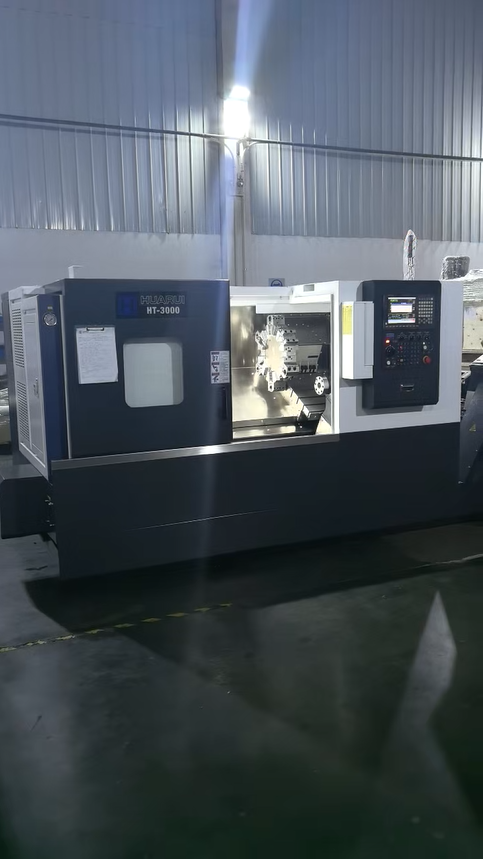
Modern smart lathes integrate real-time sensor feedback and advanced control algorithms to hold tolerances that were once reserved for grinding operations. Thermal compensation systems actively counteract minute shifts caused by temperature fluctuations, while high-resolution linear scales monitor tool position with sub-micron resolution. The result is a turning process that consistently delivers surface finishes below Ra 0.2 µm and dimensional accuracies within ±1 µm, even during unmanned overnight runs.
Vibration damping structures and hydrostatic guideways eliminate micro-chatter that would otherwise degrade part quality. By pairing these mechanical innovations with in-process measurement probes, the lathe automatically offsets tool wear and adjusts cutting parameters on the fly. This closed-loop methodology ensures that each part meets its specified geometry without manual intervention, slashing scrap rates and removing variability from the production line.
The leap to micron-level capability isn't solely about hardware—it's equally dependent on the digital twin technology that simulates every cut before metal touches tool. Operators can validate programs, predict deflection, and optimize toolpaths in a virtual environment, translating directly to higher real-world accuracy. For shops dealing with aerospace or medical components, this fusion of physical precision and digital foresight transforms the lathe from a roughing workhorse into a finishing center that rivals dedicated grinding machines.
Seamless Integration into Your Existing Workflow
Getting started shouldn't mean overhauling how you work. Our platform is designed to slide right into your current setup, whether you rely on email, project management tools, or custom dashboards. It syncs effortlessly with the apps your team already uses, so there's no steep learning curve or disruption to your daily rhythm. You can keep doing things your way, just with a smoother, more connected experience.
We've built flexible APIs and pre-built connectors for the most popular tools, making setup a breeze. That means less time wrestling with integrations and more time focusing on what matters—moving projects forward. Whether you need to pull in data from a spreadsheet, trigger actions based on calendar events, or send updates to a chat app, it all happens behind the scenes without manual copy-pasting or scattered information.
And because every workflow is unique, you can customize how and when things sync. Choose the triggers, set the frequency, and map the data exactly how you want. No rigid structures forcing you to adapt—just genuine flexibility that respects your established processes while quietly making them better.
Boosting Throughput Without Sacrificing Quality
Balancing speed and precision often feels like a tug-of-war—push too hard on output and defects creep in, but hold back and deadlines slip. The real trick lies in embedding quality checks into the workflow rather than treating them as a final hurdle. By refining processes in parallel with production, teams can hit faster rates while still meeting rigorous standards. This approach relies on early detection of variations, allowing adjustments before they cascade into larger issues.
Automation plays a key role here, but not the kind that simply replaces human oversight. Smart tools that learn from past patterns can flag anomalies in real time, letting operators focus on tricky edge cases. This blend of machine efficiency and human judgment keeps the line moving without letting defects pile up. It’s about working smarter, not just harder, and building a culture where throughput and quality aren’t competing forces but complementary goals.
Future-Proofing Your Manufacturing Capabilities
Manufacturing agility isn't about chasing every trend. It's about building systems that adapt before you need them to. Start by questioning the rigidity in your current processes—where do bottlenecks form when demand shifts? A future-proof line isn't the one with the most sensors; it's the one where a change in material input doesn't trigger a cascade of reconfiguration delays. Invest in modular cells that can be reprogrammed in hours, not weeks, and train your teams to think in terms of capability blocks rather than fixed sequences.
Data often becomes noise without context. Instead of drowning in dashboards, focus on a handful of signals that actually predict maintenance needs or quality deviations. For instance, vibration patterns from a spindle can tell you more about tool wear than a calendar-based replacement schedule ever will. Pair these insights with a culture where operators feel safe flagging anomalies—technology only future-proofs if people trust it. The goal isn't a lights-out factory; it's a facility where human judgment and machine precision play off each other's strengths.
Supply chains are brittle when they rely on a single geography or supplier tier. Map your dependencies not just by cost but by recoverability. Could you switch to a different alloy if a mine floods? Can your contract manufacturer pivot to a backup blueprint without retooling for months? Resiliency also lives in the details: stockpiling long-lead components, cross-training teams, and designing products with leeway in specifications. The manufacturers who thrive in disruption aren't always the biggest—they're the ones who treat every shock as a rehearsal for the next.
Real-World Applications in Aerospace and Medical Device Manufacturing
The rigorous demands of aerospace engineering have driven innovations that now directly benefit medical device manufacturing. In aerospace, components must withstand extreme temperatures, intense vibrations, and high stress without failure—requirements that closely mirror the durability and precision needed in implants and surgical tools. For example, advanced titanium alloys originally developed for jet engine airfoil cooling are now used to create lighter, stronger hip and knee replacements that resist fatigue over decades of use. Similarly, the micro-drilling techniques perfected for turbine blade cooling holes have been adapted to manufacture minimally invasive surgical instruments with complex internal channels, allowing for faster patient recovery.
Surface treatment technologies from the aerospace sector have also found critical applications in medical devices. The plasma spray coatings used to protect turbine blades from extreme heat have evolved into biocompatible hydroxyapatite coatings that promote bone integration in dental implants and spinal fusion cages. These coatings are applied with the same robotic precision that ensures uniformity on aircraft parts, resulting in medical surfaces that encourage tissue adhesion while resisting corrosion. Meanwhile, the non-destructive inspection methods like phased array ultrasonic testing, essential for detecting subsurface flaws in composite aircraft wings, are now employed to verify the integrity of ceramic hip joints and carbon-fiber prosthetic limbs without damaging them, ensuring every patient-specific implant meets the highest safety standards.
The cultural crossover between these industries has reshaped quality control philosophies. Aerospace's statistical process control and failure mode effects analysis have been adopted by medical device makers, shrinking defect rates to near-zero levels required for Class III life-sustaining devices. Additive manufacturing, pioneered for rapid prototyping of aerodynamic parts, now prints patient-specific surgical guides and porous spinal interbody fusion devices with lattices mimicking cancellous bone. The shared DNA is evident in cleanroom protocols: the same ISO 14644 Class 5 environments that protect satellite optics from particulate contamination safeguard implantable electronics during assembly. This cross-pollination ensures that breakthroughs in one field rapidly elevate the other, blurring the line between what flies above the clouds and what saves lives beneath them.
FAQ
They are tailored machining systems that automate turning operations to produce high-precision components, designed specifically to meet unique manufacturing requirements.
By integrating advanced CNC controls, precise tooling, and automated material handling, they minimize human error and achieve tight tolerances consistently.
Aerospace, medical, automotive, and electronics industries rely on them for complex, high-accuracy parts like implants, connectors, and engine components.
Absolutely, they can be configured for flexible setups, allowing efficient changeovers between small batches without sacrificing precision.
Key factors include the material types, desired tolerances, production volume, and necessary secondary operations like drilling or milling integration.
Yes, modern custom lathes often include sensors and connectivity features for real-time performance tracking and predictive maintenance.
It varies from a few months to over a year depending on complexity, but collaboration during the engineering phase helps streamline the timeline.
Providers usually offer comprehensive training, remote diagnostics, and on-site service to ensure continuous, optimal operation.
Conclusion
In today's competitive landscape, producing intricate components with tight tolerances demands more than off-the-shelf automation. We engineer custom automatic lathe solutions that adapt directly to your part geometry and material challenges, whether you're machining exotic alloys or micro-scale features. By embedding smart feedback systems, our lathes maintain micron-level accuracy over extended runs, compensating for tool wear and thermal drift in real time. What truly sets our approach apart is the ease of integration: we map our controls and interfaces to your existing MES and ERP systems, so you can deploy advanced automation without reworking your entire production line. This means less downtime during onboarding and a faster path to high-precision output.
Boosting throughput while preserving part integrity is a delicate balance, which we achieve through adaptive feed rates and optimized tool paths that reduce cycle times without introducing stress or vibration. Our systems are built to evolve with your needs, accommodating new programs and future process upgrades without major overhauls—a critical factor for manufacturers investing in long-term capability. Real-world deployments in aerospace and medical device manufacturing speak to this resilience: one customer reduced scrap rates by 40% on spinal implant components, while another achieved process capability indices exceeding 1.67 on critical turbine parts. These outcomes stem from a ground-up philosophy where every lathe is conceived to meet your exacting standards, not retrofitted to approximate them.
Contact Us
Contact Person: Tim
Email: [email protected]
Tel/WhatsApp: +86 15522553731
Website: https://www.winnrui-cnc.com/