

Complete Folding Carton Cutting Die Making Equipment Essentials for Packaging Success
2026-09-03
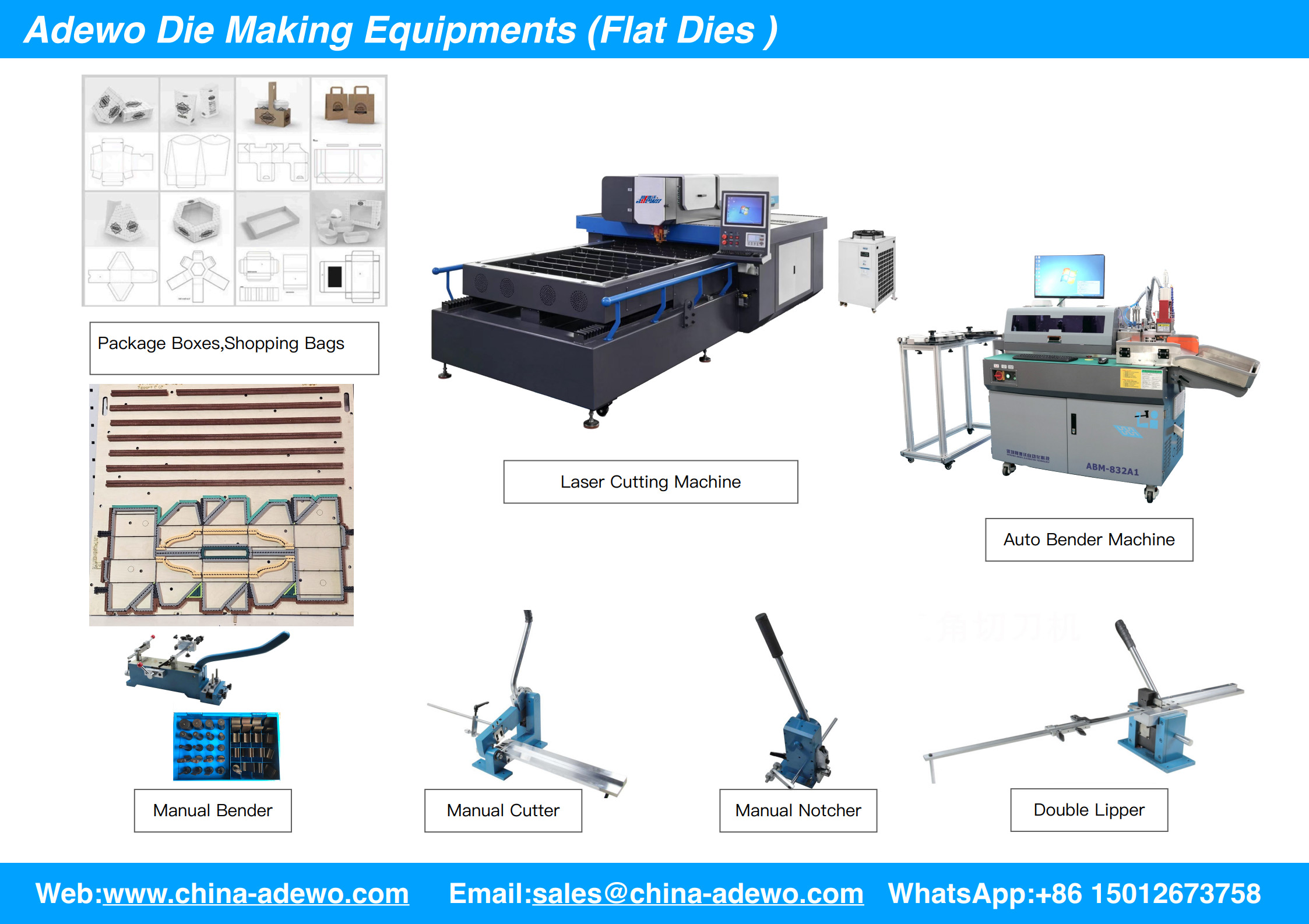
What separates a folding carton that snaps together flawlessly from one that jams the folder-gluer? The answer usually hides in the cutting die—and the equipment used to make it. If you're a packaging converter chasing higher throughput and fewer rejects, understanding the core machinery behind die making isn't just a technical detail; it's the foundation of your packaging success. In this guide, we’ll walk through the essential equipment for folding carton cutting die production—laser cutters, rule processors, bending machines, and more. And we’ll show why choosing proven systems like ADEWO can eliminate the real-world bottlenecks that quietly eat into your margins.
Tooling Geometry That Keeps Fold Lines Crisp Without Cracking the Board
A well-designed creasing rule doesn't just dent the surface—it rearranges the fibers just enough to create a hinge without snapping them. The key is a rounded nose profile, typically with a radius between 0.3 and 0.8 mm depending on board thickness, paired with a narrow channel underneath. That combination lets the board compress into a controlled valley rather than a sharp V, so the outer layer stays intact while the inner plies delaminate cleanly along the intended line.
Tooling angle matters more than most operators realize. If the rule's shoulder angle is too steep—say, approaching 90 degrees—the board experiences a sudden stress concentration right at the edge of the crease, which cracks the top liner on thicker recycled stock. A shallower shoulder, often 50 to 60 degrees, spreads the deformation over a wider zone. This creates a visible, consistent groove that guides the fold without leaving a brittle micro-fracture that turns into a blowout on the folder-gluer.
For boards with heavy clay coating or high recycled content, the trick is to combine a slightly deeper channel with a polished, low-friction rule surface. Shallow channels force the board to stretch too much over the rule tip, while deep ones let it buckle unpredictably. Polishing removes microscopic burrs that act as tear initiators. When the geometry matches the stock's caliper and stiffness, the crease holds its memory—crisp on the outside, resilient on the inside, and ready to fold without a single hairline crack along the spine.
Why Rotary Die Stations Demand Tighter Tolerances Than Flatbed Setups
In a rotary die station, the cutting action happens along a narrow, constantly moving contact line between the die roller and the anvil roller. Any variation in radial runout, bearing clearance, or shaft deflection gets magnified because the entire cutting force is concentrated on that thin strip of contact. A few microns of misalignment can shift the pressure enough to leave uncut fibers or cut too deep into the liner. Flatbed setups spread the force across a much larger platen area, so minor surface irregularities tend to average out rather than creating localized failures. That fundamental difference in force distribution is what forces rotary stations into a much tighter tolerance band.
Rotary die cutting also runs at continuous, often high-speed web travel. The die roller and anvil must stay perfectly synchronized in both surface speed and angular position. Even a tiny difference in effective circumference—caused by thermal expansion, gear backlash, or re-grinding without recalibration—leads to skidding, smearing, or uneven die penetration. Flatbed presses operate intermittently, with the material stopped and re-registered for each cycle, so small drifts in timing or alignment can be corrected between hits. Rotary systems get no such reset, which means every mechanical component needs to hold its position within micrometers just to keep the cut quality stable across millions of cycles.
Another factor is the nature of the products typically run on rotary lines. These are often continuous web processes feeding downstream converting steps like folding, laminating, or packaging. A slight variation in cut depth or land width can throw off the entire downstream registration. Because the rotary station cannot stop to compensate, the tooling and station alignment must be built to eliminate variability from the start. Flatbed setups, by contrast, are used more often for sheet-fed or batch work where each piece can be inspected and adjusted independently, giving operators a tolerance buffer that rotary lines simply don’t have.
The Overlooked Art of Setting Balanced Knife Pressure Across a Full Sheet
Most people chase the perfect cut by fiddling with speed or blade depth, but the real culprit behind inconsistent results is usually uneven knife pressure across the sheet. Run your hand over a well-used cutting mat and you'll feel what the blade feels: dips near the edges, a soft belly in the middle, and subtle ridges from past projects. Ignoring those shifts means the same setting that slices cleanly on the left side can chew through the carrier sheet on the right.
A better approach is to stop treating pressure as a single number and start thinking of it as a map. Before committing a full design, cut a small test grid in each corner and one dead center using the same material and blade. If the center barely kisses the backing while the corners are nearly through, the pressure needs a slight reduction, or the material needs a shim under the low spots. Sometimes the fix isn't the machine at all, it's rotating the sheet so the worn zone of the mat doesn't line up with the most detailed part of the design.
Once you find settings that work, write them down with the date and mat condition. That sounds old-fashioned, but it saves you from relearning the same lesson every time a new roll of vinyl shows up. Balanced pressure is less about a magic dial position and more about paying attention to how the blade responds to the surface it actually meets, not the one you assume is flat.
Smart Ejection Strategies for Intricate Cutouts and Narrow Bridges
Ejecting parts with intricate cutouts and narrow bridges demands a shift away from conventional pin placement. Instead of relying on a fixed grid, the ejection sequence must be choreographed around the weakest sections of the geometry. Start by mapping the stress concentrations during the opening stroke—thin bridge areas tend to cling to the core side long after the surrounding walls have released. Placing angled ejector sleeves or blade ejectors directly beneath these bridges lets you apply a gradual lifting force, rather than a sharp point load that would snap the feature.
For tall, slender cutouts, a two-stage ejection cycle often works better than a single push. First, the main plate lifts the entire part by a few millimeters to break the initial adhesion. Then, smaller secondary ejectors activate inside the cutout pockets, pushing gently against internal ribs or bosses that are otherwise hard to reach. This staged approach prevents the part from tilting or catching on the mold's standing steel, which is a common root cause of white marks and micro-cracks near the narrow bridges.
Material choice also plays a role in smart ejection. For glass-filled or highly crystalline resins, the mold surface texture can be tuned to reduce static cling—micro-venting along the bridge areas helps break the vacuum that forms during cooling. Pair this with ejector pins that have a slightly domed or textured tip, and you avoid the shiny witness marks that often reveal themselves on glossy part surfaces. The goal is to spread the ejection force over many small contact points, never concentrating it on a single thin web.
When In-House Laser Cutting Outperforms Traditional Rule Bending
In-house laser cutting tends to pull ahead of traditional rule bending when the job involves intricate cutouts, tight internal radii, or shapes that would require multiple steel rule dies and secondary finishing. A laser follows a digital path directly, so it can handle sharp corners, narrow slots, and fine perforations that often crack or deform under a bent rule. This is especially true for prototypes and short-to-medium runs, where the cost and lead time of building, testing, and storing physical tooling quickly outweigh any per-piece speed advantage of die cutting.
Another area where laser cutting outperforms rule bending is with newer or frequently revised designs. Changing a rule die means recutting the steel blade or starting over, whereas updating a laser file takes minutes. Materials also matter: thin plastics, films, and gasket materials can curl or tear under mechanical pressure, while a non-contact laser leaves edges clean without tool wear. For shops that already use CAD-driven workflows, moving from design to finished part on the same day is often only realistic with an in-house laser.
Machine Health Checks That Prevent Micro Shifts Before They Cost a Run
A spindle that’s a few microns out of true doesn’t announce itself. It shows up as a scrapped part, a chatter mark, or a dimension that drifts only after the machine warms up. Regular health checks—backlash measurements, thermal growth mapping, vibration signatures—catch these micro shifts while they’re still adjustments, not failures.
The trick is tracking trends over time instead of waiting for an alarm. If a ballscrew’s compensation value creeps upward three weeks in a row, that’s a clue. Swap the worn thrust bearing now, and the next production run stays within tolerance. Skip it, and the run costs you in rework, lost hours, and a customer who notices.
FAQ
You'll need a laser cutting machine for the die board, a rule processing unit to cut and notch the steel rules, an automatic bending machine to create precise angles, and a stripping table or machine for removing waste. A hydraulic or mechanical die cutting press is also essential for testing the die before it goes into production.
Laser cutting delivers far tighter tolerances and cleaner edges than manual sawing. It can handle complex carton outlines, nicks, and creasing channel layouts without the vibration and drift that often compromise accuracy on jigsaws. That precision reduces the need for hand finishing and shortens setup time on the press.
Automatic bending machines eliminate the inconsistencies of hand bending. They follow the CAD file exactly, producing uniform angles and lengths, which means the steel rules seat flush in the laser-cut kerf. That leads to cleaner cuts, fewer popped rules during die cutting, and easier make-ready on the press.
Stripping and blanking tools remove the waste from between and around cartons after die cutting. Without them, operators spend hours pulling out scrap by hand, which slows down production and risks damaging the cartons. Dedicated stripping units or pins built into the die help separate the finished blanks cleanly, especially on long runs.
Look for a press with robust impression strength, accurate registration systems, and quick-change die mounting. For carton work, the ability to handle a range of board thicknesses and a stripping station with adjustable pins matter more than high speed alone. Also check that the press can maintain consistent pressure across the full sheet to avoid partial cuts.
Regular cleaning of laser optics and fume extraction systems prevents power loss. For bending machines, lubricate the moving parts daily and recalibrate the angle stops monthly. Rule processors need sharp blades and clear chip evacuation, while die cutting presses benefit from scheduled checks of the impression adjustment and chase wear.
Laser systems should have enclosed cutting areas with interlocked doors and proper fume extraction. Bending machines need two-hand controls or light curtains to prevent finger injuries. Rule cutting equipment must include blade guards and emergency stops. For die cutting presses, photoelectric guards and a mechanical lockout during die changes are essential.
When the design file flows directly to the laser, bender, and rule processor, you eliminate manual measurements and transcription errors. The CAD file drives the kerf width, rule length, and bend angles, so all components fit together without hand adjustment. That shortens lead times and makes repeat orders nearly identical to the first run.
Conclusion
Achieving reliable folding carton production starts well before the press run. Tooling geometry deserves more attention than it typically receives: a crease rule with the right profile and depth keeps fold lines crisp while the board's surface stays intact, avoiding the hairline cracks that ruin premium packaging. In rotary die stations, this becomes even more demanding. The cylindrical setup means every millimeter of circumference has to match the flat layout exactly, or registration drift and uneven cuts appear within a few thousand sheets. That is why rotary tooling is machined to tolerances far tighter than what most flatbed systems require. Alongside geometry, knife pressure distribution across the full sheet is an overlooked but decisive factor. A slight imbalance—heavier kiss-cut pressure near the gripper edge, lighter at the tail—translates into partial cuts that slow stripping or, worse, damage the cutting plate. Regular spot checks with pressure-indicating film and incremental adjustment of individual rule heights prevent these hidden inconsistencies from becoming production bottlenecks.
Ejection and material handling are equally essential. Intricate cutouts and narrow bridges tend to cling to the die or tear during stripping if the ejection strategy is an afterthought. Positioning ejector rubber close to the cut line, choosing the right durometer for the board caliper, and setting up pin systems that work with the sheet travel direction all reduce downtime. For highly complex profiles or short runs, in-house laser cutting often makes more sense than traditional rule bending. Laser-cut dies achieve corner radii and slot widths that hand-bent steel rules cannot replicate, and they eliminate the spring-back that degrades accuracy over time. Finally, machine health checks act as an early warning system. Measuring rail wear, checking bearing play, and verifying flatness of the cutting bed catches micro shifts before they produce a full run of rejects. Together, these elements form a practical foundation for consistent carton die making.
Contact Us
Contact Person: KAELYN LEE
Email: [email protected]
Tel/WhatsApp: +86 15012673758
Website: https://www.china-adewo.com