

Best RCCB for Safe and Reliable Electrical Protection
2026-10-07
Choosing the right RCCB isn’t just about meeting code—it’s about trusting a device to react before danger does. Electrical faults happen in milliseconds, and a reliable residual current circuit breaker can mean the difference between a nuisance trip and a real disaster. In this guide, we break down what makes an RCCB genuinely safe and dependable. Along the way, you’ll see why ETEK has become a go-to name for professionals who refuse to gamble with protection.
What Actually Matters When Picking an RCCB (Not Just the Price Tag)
An RCCB that trips when it should and stays quiet when it shouldn't depends on a handful of details that rarely show up on a price sticker. Residual current rating is the obvious one, but for many homes and small workshops the real headache is nuisance tripping caused by moisture, aging appliances, or a mix of electronic loads. A 30 mA device covers personal protection in most cases, while 100 mA or 300 mA units are better reserved for fire prevention or equipment protection where a single circuit feeds multiple sockets.
Type matters more than the shell color. A Type AC unit is fine for basic resistive loads, but anything with a switching power supply, inverter drive, or variable-speed motor will eventually produce smooth DC residual currents that can blind an AC-only device. Type A handles pulsating DC, while Type B steps in for three-phase systems with frequency converters or EV chargers. Also check the breaking capacity and the actual number of poles: a four-pole unit on a three-phase supply is not automatically the right call if the neutral isn't switched or the earthing system creates a different fault path.
Finally, look at the environment and the manufacturer's test reputation. Dust, vibration, condensation, and long cable runs can all change how the device behaves in real conditions. A cheap unit may pass a bench test but become unreliable after a year near a washing machine or outdoor distribution board. Spending a bit more on a product with clear derating curves, local approvals, and a solid track record in similar installations usually saves more time and money than chasing the lowest unit cost.
The Overlooked Difference Between Type AC, A, and B RCCBs
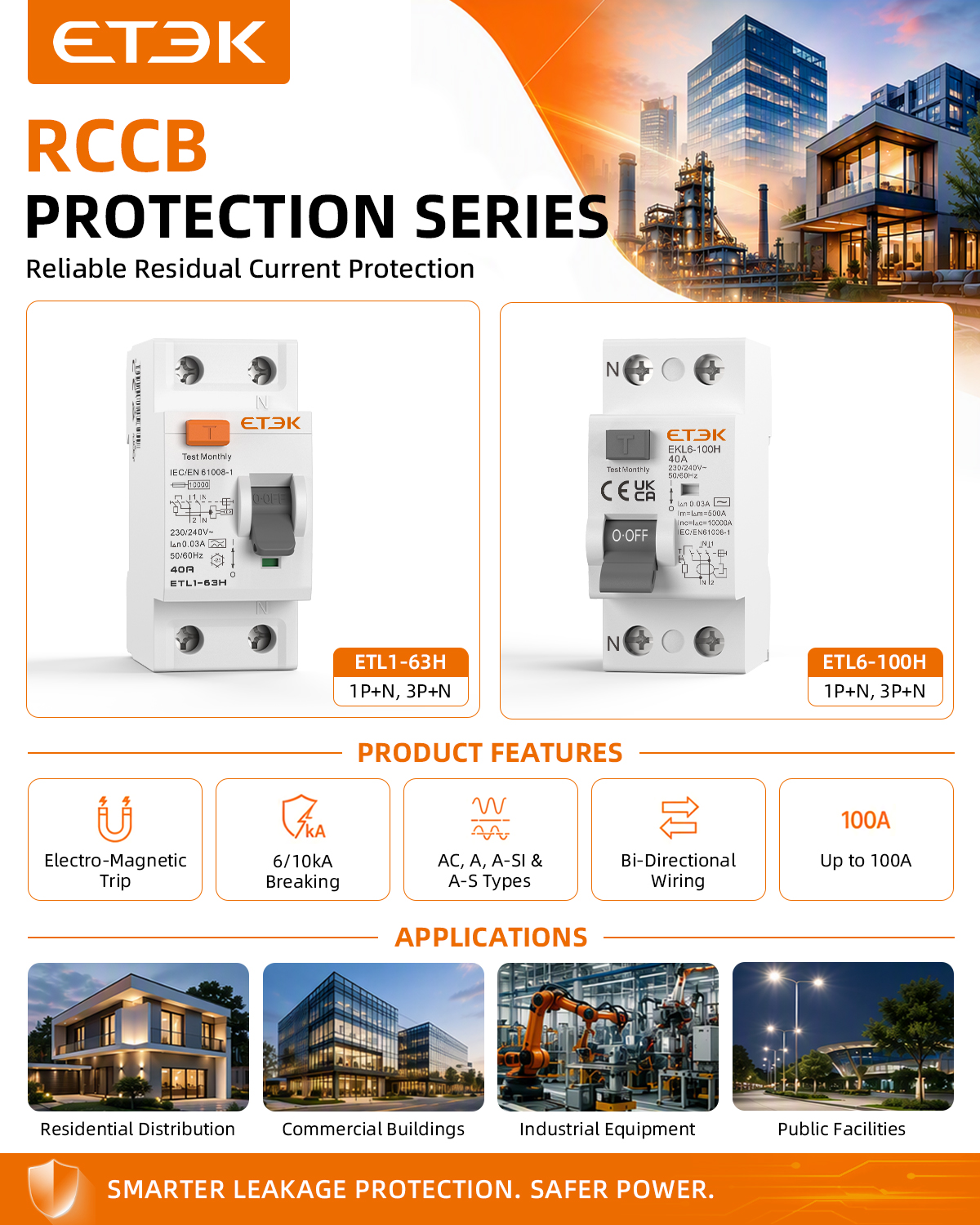
Most electricians learn early on that an RCCB trips when it detects leakage current, but the type designation often gets treated as a minor detail. In practice, Type AC, A, and B respond to completely different fault signatures. A Type AC device only reacts to pure sinusoidal AC residual currents, which means it stays silent during faults involving rectified or pulsating DC components. Type A expands the response to include pulsating DC and smooth DC up to 6 mA, making it the minimum sensible choice for circuits feeding electronic loads like washing machines or LED drivers. Yet even Type A will miss the smooth DC produced by three-phase rectifiers, variable speed drives, or EV chargers. That is where Type B becomes essential, as it trips on both AC and smooth DC residual currents up to higher thresholds, often with built-in frequency response for mixed-frequency systems.
The overlooked difference often shows up in real installations where a Type AC is still fitted because it is cheaper and “has always worked.” But if the load involves any semiconductor switching, a fault can push DC onto the protective earth conductor. This DC can blind a downstream Type AC RCCB, holding its core in saturation and preventing it from tripping even when a dangerous AC fault occurs later. So the wrong choice does not just fail on the DC fault itself; it also compromises the safety function for all subsequent faults. That is why many national wiring codes now mandate Type A as a minimum for socket outlets, and Type B for circuits with EV charging points, PV inverters, or industrial motor drives. The difference is not purely about tripping current magnitude; it is about what the residual current waveform actually looks like when electronics fail.
Another subtlety is the way these types handle high-frequency leakage from modern appliances. Type AC devices are typically tested only at 50/60 Hz, so they may not respond predictably when a switched-mode power supply leaks current at tens of kilohertz. Type A improves this somewhat for pulsating DC but still has limits above a few hundred hertz. Type B designs often include frequency-dependent tripping curves and are built to cope with mixed-frequency residuals up to 2 kHz or more. Selecting a Type AC in such an environment is like installing a smoke detector that only recognizes one specific burn pattern: it gives a false sense of security while the real hazard passes unnoticed. For designers and installers, reading the load profile before choosing the RCCB type matters more than the nominal residual current rating. A 30 mA Type AC and a 30 mA Type B look identical on paper, but under real fault conditions their behavior can be the difference between a tripped breaker and a silent, energized fault path.
Real Reasons RCCBs Trip (And When You Should Worry)
Moisture is the most common culprit behind an RCCB that trips without an obvious overload. Outdoor sockets, junction boxes with degraded gaskets, and even condensation inside a consumer unit can create a path for a few milliamps of current to leak to earth. If the trip happens after rain or high humidity and resets once things dry out, the cause is usually environmental rather than a failing breaker. Check for water ingress before replacing the RCCB.
Repeated tripping with no clear pattern is more concerning. Unplug everything on the affected circuit and reset the RCCB. If it still trips, the fault is in the fixed wiring or the RCCB itself, which means it is time to call an electrician. Also worth paying attention to are appliances with heating elements, such as kettles or washing machines, where insulation breakdown can create intermittent earth leakage long before the appliance stops working. A single trip is rarely an emergency, but any tingling sensation from metal casings or a trip that recurs within minutes should be treated as a genuine hazard, not a nuisance.
Installation Mistakes That Undermine Protection
Many protection systems fail not because of faulty equipment, but because of the way they were installed. One frequent error is skipping proper grounding—without a solid earth connection, surge protectors and circuit breakers can't redirect excess voltage safely. Another common mistake is mixing incompatible components, such as using wiring with the wrong gauge or connectors that don't match the device's rating. These oversights can create resistance points that overheat or leave sections of the circuit completely unprotected.
Incorrect wiring order is just as damaging. For instance, placing a fuse after the protected device rather than before it means the fault current can reach sensitive electronics before the fuse blows. Similarly, reversing polarity on DC systems or swapping line and neutral on AC circuits can cause protective relays to misjudge conditions, leaving gaps in coverage. Even a small error like leaving excess slack in a ground wire can introduce inductance that slows the response of a safety device.
Regular inspection after installation is also overlooked. Vibration, temperature cycles, and corrosion can loosen terminals over time, creating intermittent connections that fail exactly when a surge or short circuit occurs. A thorough check of torque values, insulation integrity, and routing away from heat sources makes a noticeable difference. The goal isn't just to install protection—it's to install it in a way that keeps working when it's actually needed.
Testing Your RCCB: A Habit That Saves Lives
Most people don't think about their RCCB until something goes wrong. That little switch on your electrical panel is meant to trip within milliseconds when it detects a leakage current—long before that current can pass through a human body. But like any mechanical device, an RCCB can seize up, gather dust, or lose sensitivity over time. Pressing the test button every month isn't just a nice-to-have; it's the only way to know whether the device will actually do its job when a real fault occurs.
The habit takes about ten seconds. You press the small button marked “T” or “Test.” The lever should snap down immediately, cutting power to the circuit. If it doesn't trip, or if it trips but won't reset properly, that's a red flag. Some people hesitate because they don't want to reset digital clocks or reboot a router. But think about it: a tripped RCCB during a test costs you a few minutes of inconvenience. A faulty RCCB during a real fault could cost someone their life.
Make it part of your routine—link it to paying rent, checking smoke alarms, or the first Saturday of each month. Write it on the calendar if you have to. A functioning RCCB is invisible protection until the moment it matters, and the only way to keep that protection sharp is to test it regularly. Don't wait for a near-miss to find out yours was quietly failing.
Matching RCCB Sensitivity to Your Home’s Actual Risk
Choosing the right RCCB sensitivity starts with mapping where real danger exists in your home. Circuits serving bathrooms, kitchens, outdoor sockets, or any space where water and electricity may meet deserve a 30 mA device—this threshold is low enough to disconnect before a harmful current passes through a person. By contrast, a dry living room circuit with few appliances can often operate safely with a 100 mA or 300 mA unit, reducing nuisance tripping without ignoring fire risks.
Instead of installing the same RCCB everywhere, divide the installation into risk zones. Damp locations and child-accessible outlets require immediate, high-sensitivity protection, while dedicated circuits for fixed equipment like water heaters or HVAC systems may tolerate a higher threshold if they are grounded and maintained. This zoning approach not only improves safety but also keeps everyday power interruptions to a minimum.
FAQ
Look for a genuine 30mA trip threshold when personal safety is involved, plus a breaking capacity that comfortably exceeds your panel's expected fault current. Solid terminals that hold wires without slipping and clear labeling for torque settings also make a practical difference during installation.
It continuously compares the current flowing out on the live wire with the current returning on the neutral. If even a small difference appears—typically 30mA or less—it means current is leaking to earth, possibly through a person, so the RCCB trips within milliseconds to cut the circuit.
For rooms with wet conditions or where kids are around, stick with 30mA. If you're mainly guarding against fire risks from degraded wiring or large appliances, a 100mA or 300mA unit can work, but it won't offer direct personal shock protection.
Type AC only recognizes pure sinusoidal earth faults, while Type A also detects pulsating DC leakage from electronics with rectifiers, like washing machines, chargers, and LED drivers. Modern homes are full of such loads, so Type A is usually the safer long-term choice.
Never treat it as set-and-forget. Mechanical parts can stiffen or degrade. Press the test button every couple of months and after any electrical work nearby. If the lever doesn't trip instantly or feels sluggish, replace the unit rather than waiting for a real fault.
It creates a controlled leakage current inside the device, mimicking a fault condition. When everything works properly, the RCCB should trip immediately. If it doesn't, the protection you think you have isn't actually there.
You can, but it's risky. An RCCB won't respond to overloads or short circuits—only to earth leakage. Without an MCB or RCBO in the same circuit, a sustained overcurrent can cook the wiring and start a fire while the RCCB stays happily closed.
Loose terminal screws, mixing up neutrals from different circuits, or relying on a poor earthing system are common culprits. Even a brand-new, high-quality RCCB can't compensate for sloppy wiring, so torque settings and clear circuit separation matter more than most people assume.
Conclusion
Choosing the best RCCB starts with understanding what your home actually needs, not just grabbing the cheapest unit on the shelf. Type AC devices only catch sinusoidal AC leakage, which is fine for basic resistive loads but useless if you run inverter-driven appliances, EV chargers, or anything with DC components. Type A covers pulsating DC and is a safer default for modern households, while Type B handles smooth DC and high-frequency noise from solar inverters and industrial equipment. Matching sensitivity to real risk also matters: 30 mA is the human-safety standard for sockets and wet areas, but a 100 mA or 300 mA unit may be enough for fire protection on a main incomer where nuisance tripping would be a bigger hazard. A dependable RCCB should have clear trip indicators, sturdy terminals, and genuine certification marks rather than a suspiciously low price.
Tripping is not automatically a reason to panic, but it is a signal worth reading. Persistent moisture in outdoor fittings, damaged appliance cords, or accumulated dust in sockets can cause leakage, while a breaker that trips only when a certain device starts usually points to that device. The dangerous sign is frequent or random tripping with no obvious trigger, which can mean degraded insulation or a developing earth fault. Installation errors undermine even the best unit: reversed line and neutral, loose terminations, or a shared neutral between circuits let leakage bypass the RCCB. Finally, press the test button monthly—not just when you remember. If it does not trip within the specified time, replace it. A habit of testing and a clear mental map of which circuits are protected do more for safety than any brand name ever will.
Contact Us
Contact Person: Andy
Email: [email protected]
Tel/WhatsApp: +86 13356133008
Website: https://www.etek-china.com/