

Best Knife Valve Options for Reliable Flow Control in Demanding Systems
2026-10-05
When harsh media, high pressures, or abrasive slurries threaten to compromise your process, choosing the right knife valve isn’t just about buying a component—it’s about securing uptime. Yet too many plant engineers discover too late that a generic valve can’t handle the stress of a demanding system. From mining tailings to chemical transfer, the best knife valve options combine robust sealing, low maintenance, and precise throttling under conditions that push ordinary designs to failure. Among the names trusted for such reliability is DRIFCO, a brand focused on flow control solutions that stand up where others fall short. In this post, we’ll cut through the clutter and examine the top knife valve choices engineered for long-term performance in the toughest industrial environments.
Where Knife Gate Valves Earn Their Keep in Demanding Service
In mining slurries and tailings lines, knife gate valves hold up because the blade cuts through settled solids on every stroke—no dead spots for material to pack into. The seats are often field-replaceable while the valve stays in the line, which matters when a shutdown costs more than the valve itself.
Pulp and paper mills rely on them for stock lines carrying up to 12% consistency. A standard gate would clog within hours, but the knife edge shears through fiber bundles and the full-bore opening keeps pressure drop low. Abrasive services like fly ash or bottom ash in power plants punish conventional valves; here, hardened blades and ceramic-lined bodies keep the valve functioning long after a rubber-lined butterfly would have washed out.
Wastewater plants with raw sewage and grit see the biggest benefit. Solids that would jam a plug valve pass through the open port without obstruction, and the downward closing action scrapes the seat clean. Even with scaling or buildup on the walls, the gate still seats sufficiently to isolate a line for maintenance—nothing else in that price range does the same job.
Matching Materials to Abrasive Slurries Without Overpaying
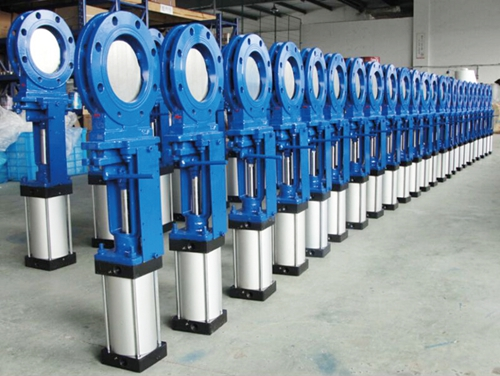
Selecting the right material for handling abrasive slurries usually starts with a simple question: what exactly is in the fluid? Particle size, hardness, and concentration matter more than the base liquid. A pump or valve lined with natural rubber can handle fine, round particles at moderate velocities, yet the same lining fails quickly when sharp crushed rock is involved. Checking the slurry's composition before buying expensive alloys often reveals that a mid-range polyurethane or ceramic coating does the job just as well.
Many engineers jump straight to high-chrome iron or tungsten carbide, assuming abrasion resistance scales with price. That is rarely true. The cheapest option that survives is the one matched to the specific wear mechanism—sliding abrasion, impact, or erosion-corrosion. For example, a hard ceramic insert makes sense where particles slide across a surface under pressure, but it may crack under heavy impact. Softer elastomers, by contrast, absorb impact energy and can outlast harder materials in certain slurry lines.
A practical way to avoid overpaying is to test small samples under real flow conditions rather than relying on generic wear tables. Run a side-by-side comparison of candidate materials in a bypass loop for a few weeks, then measure thickness loss. This approach costs far less than a premature failure or an over-specified alloy. It also gives you data tied to your own slurry, not a supplier's idealized lab test, so the final choice is both defensible and economical.
Unidirectional vs Bidirectional Sealing and Why It Matters
A unidirectional seal only holds pressure from one side. Flip it around, and it will leak almost immediately. In a typical hydraulic cylinder, the rod seal is a classic unidirectional design: it keeps oil inside the cylinder bore while letting a microscopic film ride out on the rod to lubricate the wiper. That film would never be allowed to travel the other way. Bidirectional seals, by contrast, are built to handle pressure from either side without losing their grip. They usually have symmetrical lips or special backup rings, and you'll find them in applications where the pressure differential can reverse, like in certain valves or double-acting actuators.
Why does this matter? Put a unidirectional seal in a reversing circuit and it won't just seep—it can roll, extrude, or tear because the fluid pressure is trying to push the sealing lip away from the mating surface. The result is contamination, lost efficiency, and unscheduled downtime. Bidirectional seals cost a bit more and can add some friction, but they eliminate the risk of installing the wrong orientation and failing under reverse pressure. For design engineers, the choice comes down to knowing exactly which way the pressure will act. If there's any chance of reversal, a bidirectional seal is cheap insurance compared to tearing down a machine after a seal failure.
Field-Tested Ways to Stop Gate Jamming and Seat Leaks
One reliable fix for a jammed gate comes from watching old-timers on the pipeline: before you force the handwheel, give the stem a few light taps with a brass hammer. That vibration breaks the corrosion bond between the gate and the guides. If it still sticks, back off a quarter turn and apply a thin film of anti-seize compound to the exposed threads, then work the valve slowly. Never use a cheater bar; that only bends the stem and makes the next jam worse.
Seat leaks are trickier because the damage hides behind the disc. A method that holds up in the field is to remove the bonnet, coat the seat face with a thin layer of lapping compound, and rotate the disc back and forth by hand for ten minutes. You will feel the resistance smooth out. If you need a quick patch before a shutdown, wrap one layer of PTFE tape around the seat shoulder, but mark that valve for proper lapping later. Skipping this step turns a five-minute fix into a full rebuild.
Sizing Slurry Lines for Pressure Drop Instead of Guesswork
A slurry line rarely behaves like a water pipe, and sizing it by feel invites two expensive problems. Solids drop out in low spots, and erosion accelerates where velocities climb too high. A pressure drop calculation forces you to pin down the slurry's actual properties, including solids concentration, particle size distribution, carrier liquid viscosity, and the density difference between solids and liquid. Without these inputs, any diameter you pick is just a guess with extra steps.
Start from the required dry solids throughput and the volumetric concentration. Calculate the deposition velocity for the largest particles likely to settle, then choose a pipe diameter that keeps flow safely above that threshold but below the point where wear accelerates sharply. Use a slurry friction model such as Durand or Wilson rather than a clean-water Moody chart. The resulting pressure drop per unit length, combined with static lift and fitting losses, tells you whether the pump can do the job. Iterating on diameter and velocity quickly reveals the trade-off between energy cost and capital cost.
Once the line is running, verify the calculated pressure drop with a differential pressure transmitter and a density meter. If the measured values drift from the model, adjust the input parameters such as particle size or concentration rather than applying a generic safety factor. That closes the loop and turns sizing from a one-time guess into a repeatable engineering practice.
Tough Jobs Where Knife Valves Beat Ball and Butterfly Designs
In services that move thick sludges, abrasive slurries, or fibrous pulp, ball and butterfly valves often fail because their seats and sealing surfaces get scored, packed with solids, or simply can't close through the debris. Knife valves solve this by driving a sharp, beveled gate straight through the media, cutting off flow without relying on a tight-sealing cavity that traps particles. The gate's edge slices through stringy material and pushes heavy solids out of the seat area, so the valve cycles reliably even when the line is full of gritty or sticky stuff.
Mining tailings lines, paper stock systems, wastewater sludge transfer, and biomass processing are classic examples. In these tough jobs, a ball valve's polished ball gets scratched and leaks around the stem, while a butterfly valve's disc can jam on accumulated solids and leave a wide gap because the elastomer liner is damaged. Knife valves, by contrast, have a slim profile and a full-bore opening that matches the pipe ID, so there is no sudden drop in velocity or low spot where solids build up. The gate simply retracts completely out of the flow path for a clear, unobstructed passage.
Maintenance is another reason knife valves win in severe duty. A typical knife valve has a replaceable seat and a simple packing box; when the gate or seat wears, you can swap parts without removing the whole body from the line. Ball and butterfly designs in the same harsh services often need full disassembly, lapping or replacing the ball, and new seats or liners. In plants that run continuously, that difference means hours of downtime saved and far fewer unplanned shutdowns.
FAQ
A knife valve's gate has a sharp, beveled edge that cuts through thick media, slurries, and solids. For tough services, look for reinforced body construction, a durable seat that can handle pressure and temperature swings, and a stem seal that stays tight after repeated cycles. Materials like stainless steel or hardened alloys resist abrasion and corrosion, which is critical in wastewater, mining, or chemical plants.
For abrasive slurries, a metal-seated knife valve with a hardened gate and replaceable seat rings tends to outlast soft-seated alternatives. Uni-directional designs with a lugged or wafer body can be installed to allow the gate to isolate downstream while the body cavity drains. Some manufacturers offer deflection cones or port guards to reduce wear on the seat and body.
Wafer-style knife valves are lighter and cheaper, but they need flanges on both sides for support and are harder to isolate during maintenance. Lug-style valves have threaded inserts that let you remove downstream piping while the valve stays bolted to the upstream flange, which is useful in slurry lines where block-and-bleed or dead-end service is expected.
In corrosive environments, prioritize a stainless steel body (316 or duplex), a PTFE or UHMWPE seat, and a gate material matching the chemical exposure. For severe acids or chlorides, consider alloy 20, Hastelloy, or titanium. Don't overlook the stem and packing; PTFE-impregnated packing and a 316 stem prevent leaks and pitting.
Standard knife valves are usually rated for lower pressures (up to 150 psi or so) because the thin gate and body can flex. For high-pressure service, look for a reinforced yoke, a thicker gate, and a pressure-energized seat. Some manufacturers offer high-performance knife valves rated to 300 psi or more, but always check the pressure-temperature curve for your specific media.
Keep the gate and seat area free of hardened deposits by cycling the valve regularly, flush the body cavity if the design allows, and inspect the packing gland for leaks. For abrasive services, replace the seat and gate before they wear beyond tolerance. Lubricate the stem threads on manual valves and test the actuator on automated units at scheduled intervals.
Yes, some knife valves use a resilient seated design with an elastomer sleeve or an inflatable seat to achieve bubble-tight shutoff in gas or light powder lines. A bidirectional resilient seat with a secondary seal is common. For fine powders, a valve with a purge port prevents packing contamination and keeps the gate clean.
Knife valves have a thinner gate that cuts through slurries and solids, while conventional gate valves often trap material in the body cavity, leading to seat damage and incomplete closure. Knife valves also offer a shorter face-to-face dimension and are easier to automate with pneumatic or electric actuators for on-off slurry service.
Conclusion
Selecting the right knife valve starts with understanding where these components actually outperform ball and butterfly designs. In thick, fibrous, or solids-laden flows—think mining tailings, pulp stock, wastewater sludge, or ash handling—a knife gate's thin blade slices through media and clears the seat on every stroke. That simple action prevents the packing and binding problems that plague quarter-turn valves. Material choice matters just as much as the valve style. For abrasive slurries, a hardened stainless or Ni-Hard body with a replaceable elastomer seat often delivers the longest service life without the premium cost of exotic alloys. Pay attention to sealing direction too: unidirectional valves provide a tighter shutoff in one flow path and cost less, but bidirectional designs are necessary when pressure can reverse, such as in pump isolation or tank discharge lines.
Field experience shows most gate jamming and seat leaks come from two preventable issues: solids packing behind the gate and improper seat compression. Regular flushing ports, scraper rings, or a beveled gate edge help clear debris before it hardens. For seat leaks, choosing a valve with an adjustable gland or a floating seat lets operators restore seal tightness without pulling the valve from the line. Sizing also deserves more attention than typical guesswork. Instead of matching pipe diameter, calculate pressure drop across the valve using the slurry's specific gravity, solids concentration, and flow velocity. Oversizing a knife valve can actually increase wear and cause chatter, while a properly sized valve maintains a full-port opening and steady flow. In demanding isolation tasks—particularly where solids are present or space is tight—knife valves remain the most reliable option when these material, sealing, and sizing details are handled correctly.
Contact Us
Contact Person: George
Email: [email protected]
Tel/WhatsApp: 13863633883
Website: https://www.es-fire.com